Gatewaytocomedy Ro Political Humor Funny Pictures Videos Entertainment Humor Arts
Comedy (from the Greek: κωμῳδία, kōmōdía) is a genre of fiction that consists of discourses or works intended to be humorous or amusing by inducing laughter, especially in theatre, film, stand up-upwardly comedy, tv, radio, books, or whatsoever other entertainment medium. The term originated in aboriginal Hellenic republic: in Athenian democracy, the public opinion of voters was influenced past political satire performed by comic poets in theaters.[ane] The theatrical genre of Greek one-act can be described every bit a dramatic performance pitting two groups, ages, genders, or societies against each other in an amusing agon or conflict. Northrop Frye depicted these 2 opposing sides as a "Society of Youth" and a "Social club of the Old".[ii] A revised view characterizes the essential agon of one-act as a struggle betwixt a relatively powerless youth and the societal conventions posing obstacles to his hopes. In this struggle, the youth then becomes constrained by his lack of social authority, and is left with fiddling choice only to resort to ruses which engender dramatic irony, which provokes laughter.[3]
Satire and political satire use comedy to portray persons or social institutions as ridiculous or corrupt, thus alienating their audience from the object of their sense of humor. Parody subverts popular genres and forms, critiquing those forms without necessarily condemning them.
Other forms of one-act include screwball comedy, which derives its humor largely from bizarre, surprising (and improbable) situations or characters, and blackness one-act, which is characterized by a form of humor that includes darker aspects of human behavior or human nature. Similarly scatological sense of humor, sexual sense of humor, and race humour create comedy by violating social conventions or taboos in comic means, which tin often exist taken equally offensive past the subjects of said joke. A one-act of manners typically takes as its subject a particular part of social club (usually upper-course order) and uses humor to parody or satirize the beliefs and mannerisms of its members. Romantic comedy is a popular genre that depicts burgeoning romance in humorous terms and focuses on the foibles of those who are falling in love.
Etymology [edit]

Dean Rubin says the discussion "comedy" is derived from the Classical Greek κωμῳδία kōmōidía, which is a compound of κῶμος kômos (revel) and ᾠδή ōidḗ (singing; ode).[four] The adjective "comic" (Greek κωμικός kōmikós), which strictly means that which relates to comedy is, in modern usage, generally confined to the sense of "laughter-provoking".[5] Of this, the give-and-take came into modernistic usage through the Latin comoedia and Italian commedia and has, over fourth dimension, passed through various shades of meaning.[6]
The Greeks and Romans confined their utilise of the word "comedy" to descriptions of stage-plays with happy endings. Aristotle defined comedy every bit an imitation of men worse than the average (where tragedy was an imitation of men improve than the average). However, the characters portrayed in comedies were not worse than average in every way, only insofar as they are Ridiculous, which is a species of the Ugly. The Ridiculous may be divers as a mistake or deformity not productive of pain or damage to others; the mask, for example, that excites laughter is something ugly and distorted without causing pain.[7] In the Middle Ages, the term expanded to include narrative poems with happy endings. It is in this sense that Dante used the term in the title of his verse form, La Commedia.
As time progressed, the word came more than and more than to exist associated with any sort of performance intended to crusade laughter.[six] During the Middle Ages, the term "one-act" became synonymous with satire, and later with humour in full general.
Aristotle'south Poetics was translated into Arabic in the medieval Islamic world, where it was elaborated upon past Arabic writers and Islamic philosophers, such every bit Abu Bishr, and his pupils Al-Farabi, Avicenna, and Averroes. They disassociated comedy from Greek dramatic representation and instead identified it with Arabic poetic themes and forms, such as hija (satirical verse). They viewed comedy equally merely the "art of reprehension", and made no reference to light and cheerful events, or to the troubling beginnings and happy endings associated with classical Greek one-act.
After the Latin translations of the twelfth century, the term "comedy" gained a more general pregnant in medieval literature.[8]
In the late 20th century, many scholars preferred to employ the term laughter to refer to the whole gamut of the comic, in social club to avoid the utilize of ambiguous and problematically defined genres such equally the grotesque, irony, and satire.[ix] [10]
History [edit]
Western history [edit]
Dionysiac origins, Aristophanes and Aristotle [edit]
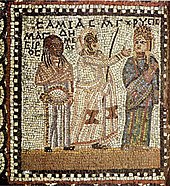
Starting from 425 BCE, Aristophanes, a comic play and satirical author of the Ancient Greek Theater, wrote twoscore comedies, 11 of which survive. Aristophanes developed his type of comedy from the earlier satyr plays, which were often highly obscene.[11] The but surviving examples of the satyr plays are past Euripides, which are much later examples and not representative of the genre.[12] In ancient Greece, one-act originated in bawdy and ribald songs or recitations concerning of phallic processions and fertility festivals or gatherings.[thirteen]
Around 335 BCE, Aristotle, in his work Poetics, stated that comedy originated in phallic processions and the light handling of the otherwise base and ugly. He also adds that the origins of one-act are obscure considering it was not treated seriously from its inception.[fourteen] All the same, comedy had its own Muse: Thalia.[ citation needed ]
Aristotle taught that comedy was generally positive for club, since information technology brings forth happiness, which for Aristotle was the ideal state, the final goal in whatever activity. For Aristotle, a comedy did not need to involve sexual sense of humour. A comedy is nigh the fortunate rising of a sympathetic character. Aristotle divides one-act into 3 categories or subgenres: farce, romantic comedy, and satire. On the other manus, Plato taught that one-act is a devastation to the self. He believed that it produces an emotion that overrides rational cocky-control and learning. In The Republic, he says that the guardians of the state should avoid laughter, "for ordinarily when one abandons himself to fierce laughter, his condition provokes a trigger-happy reaction." Plato says comedy should be tightly controlled if i wants to reach the platonic state.
Also in Poetics, Aristotle defined comedy as one of the original four genres of literature. The other three genres are tragedy, epic verse, and lyric poesy. Literature, in full general, is defined by Aristotle equally a mimesis, or false of life. Comedy is the third form of literature, being the most divorced from a true mimesis. Tragedy is the truest mimesis, followed by epic verse, comedy, and lyric poetry. The genre of one-act is defined past a certain pattern according to Aristotle's definition. Comedies begin with depression or base characters seeking insignificant aims and end with some achievement of the aims which either lightens the initial baseness or reveals the insignificance of the aims.
Commedia dell'arte and Shakespearean, Elizabethan comedy [edit]

"Comedy", in its Elizabethan usage, had a very different meaning from mod comedy. A Shakespearean one-act is ane that has a happy ending, usually involving marriages between the unmarried characters, and a tone and style that is more than light-hearted than Shakespeare'southward other plays.[fifteen]
The Punch and Judy show has roots in the 16th-century Italian commedia dell'arte. The figure of Punch derives from the Neapolitan stock character of Pulcinella.[xvi] The figure who afterwards became Mr. Punch fabricated his starting time recorded appearance in England in 1662.[17] Dial and Judy are performed in the spirit of outrageous comedy — often provoking shocked laughter — and are dominated by the anarchic clowning of Mr. Punch.[xviii] Actualization at a significant menses in British history, professor Glyn Edwards states: "[Pulcinella] went down particularly well with Restoration British audiences, fun-starved after years of Puritanism. We soon changed Punch's name, transformed him from a marionette to a paw puppet, and he became, really, a spirit of Britain — a destructive maverick who defies authority, a kind of puppet equivalent to our political cartoons."[17]
19th to early 20th century [edit]
In early 19th century England, pantomime caused its present form which includes slapstick comedy and featured the beginning mainstream clown Joseph Grimaldi, while comedy routines also featured heavily in British music hall theatre which became pop in the 1850s.[19] British comedians who honed their skills in music hall sketches include Charlie Chaplin, Stan Laurel and Dan Leno.[20] English music hall comedian and theatre impresario Fred Karno developed a form of sketch comedy without dialogue in the 1890s, and Chaplin and Laurel were among the comedians who worked for his visitor.[twenty] Karno was a pioneer of slapstick, and in his biography, Laurel stated, "Fred Karno didn't teach Charlie [Chaplin] and me all we know almost one-act. He simply taught united states most of it".[21] Film producer Hal Roach stated: "Fred Karno is non just a genius, he is the man who originated slapstick one-act. Nosotros in Hollywood owe much to him."[22] American vaudeville emerged in the 1880s and remained popular until the 1930s, and featured comedians such as W. C. Fields, Buster Keaton and the Marx Brothers.
20th century theatre and art [edit]
Surreal humour (also known as 'absurdist humour'), or 'surreal one-act', is a form of humour predicated on deliberate violations of causal reasoning, producing events and behaviours that are evidently casuistic. Constructions of surreal sense of humor tend to involve bizarre juxtapositions, incongruity, non-sequiturs, irrational or absurd situations and expressions of nonsense.[23] The humour arises from a subversion of audience'southward expectations, so that amusement is founded on unpredictability, separate from a logical analysis of the situation. The humour derived gets its appeal from the ridiculousness and unlikeliness of the situation. The genre has roots in Surrealism in the arts.[23]

Edward Lear, Anile 73 and a One-half and His Cat Foss, Anile xvi, an 1885 lithograph by Edward Lear
Surreal humour is the effect of illogic and absurdity being used for humorous effect. Under such premises, people can identify precursors and early on examples of surreal humour at least since the 19th century, such as Lewis Carroll's Alice's Adventures in Wonderland and Through the Looking-Glass, which both use illogic and absurdity (hookah-smoking caterpillars, croquet matches using live flamingos as mallets, etc.) for humorous outcome. Many of Edward Lear'southward children stories and poems comprise nonsense and are basically surreal in approach. For case, The Story of the Four Lilliputian Children Who Went Round the Earth (1871) is filled with contradictory statements and odd images intended to provoke entertainment, such every bit the following:
After a time they saw some state at a distance; and when they came to it, they found it was an island fabricated of water quite surrounded past globe. Besides that, it was bordered by evanescent isthmuses with a great Gulf-stream running most all over it, so that it was perfectly cute, and independent simply a single tree, 503 feet loftier.[24]
In the early 20th century, several advanced movements, including the dadaists, surrealists, and futurists, began to argue for an art that was random, jarring and illogical.[25] The goals of these movements were in some sense serious, and they were committed to undermining the solemnity and cocky-satisfaction of the contemporary artistic establishment. As a result, much of their art was intentionally amusing.
A famous example is Marcel Duchamp'due south Fountain (1917), an inverted urinal signed "R. Mutt". This became i of the most famous and influential pieces of fine art in history, and one of the earliest examples of the institute object movement. Information technology is also a joke, relying on the inversion of the item's part every bit expressed by its championship as well as its incongruous presence in an art exhibition.[26]
20th century film, records, radio, and television [edit]


The appearance of cinema in the late 19th century, and afterward radio and boob tube in the 20th century broadened the access of comedians to the full general public. Charlie Chaplin, through silent film, became ane of the best-known faces on Earth. The silent tradition lived on well into the late 20th century through mime artists like Marcel Marceau, and the slapstick one-act of artists like Rowan Atkinson (as Mr. Bean). The tradition of the circus clown also continued, with such every bit Bozo the Clown in the United states of america and Oleg Popov in Russia. Radio provided new possibilities — with Uk producing the influential surreal humour of the Goon Bear witness after the Second World War. The Goons' influence spread to the American radio and recording troupe the Firesign Theatre. American picture palace has produced a great number of globally renowned comedy artists, from Laurel and Hardy, the Three Stooges, Abbott and Costello, Dean Martin and Jerry Lewis, Bob Hope and Phyllis Diller during the mid-20th century, to performers like George Carlin, Bill Cosby, Joan Rivers, Robin Williams, and Eddie Spud toward the terminate of the century. Hollywood attracted many international talents like the British comics Peter Sellers, Dudley Moore and Sacha Businesswoman Cohen, Canadian comics Dan Aykroyd, Jim Carrey, and Mike Myers, and the Australian comedian Paul Hogan, famous for Crocodile Dundee. Other centres of creative comic action have been the cinema of Hong Kong, Bollywood, and French farce.
American television set has likewise been an influential force in world comedy: with American series like K*A*S*H, Seinfeld and The Simpsons achieving big followings around the earth. British television receiver comedy as well remains influential, with quintessential works including Fawlty Towers, Monty Python, Dad's Ground forces, Blackadder, and The Office. Australian satirist Barry Humphries, whose comic creations include the housewife and "gigastar" Matriarch Edna Everage, for his delivery of Dadaist and absurdist humour to millions, was described by biographer Anne Pender in 2010 as not only "the most pregnant theatrical figure of our time ... [but] the most pregnant comedian to emerge since Charlie Chaplin".[27]
Eastern history [edit]
Indian aesthetics and drama [edit]
By 200 BC,[28] in ancient Sanskrit drama, Bharata Muni's Natya Shastra divers humour (hāsyam) equally one of the nine nava rasas, or principle rasas (emotional responses), which can exist inspired in the audience by bhavas, the imitations of emotions that the actors perform. Each rasa was associated with a specific bhavas portrayed on phase. In the example of humour, it was associated with mirth (hasya).
Studies on comic theory [edit]
The phenomena continued with laughter and that which provokes it take been carefully investigated by psychologists. They agree the predominant characteristics are incongruity or dissimilarity in the object and shock or emotional seizure on the part of the subject. It has also been held that the feeling of superiority is an essential factor: thus Thomas Hobbes speaks of laughter every bit a "sudden glory". Modern investigators have paid much attention to the origin both of laughter and of smiling, as well as the development of the "play instinct" and its emotional expression.
George Meredith said that "One excellent exam of the civilization of a state ... I take to be the flourishing of the Comic thought and Comedy, and the test of truthful Comedy is that it shall awaken thoughtful laughter." Laughter is said to exist the cure for being sick. Studies show that people who laugh more often become ill less.[29] [30]
American literary theorist Kenneth Burke writes that the "comic frame" in rhetoric is "neither wholly euphemistic, nor wholly debunking—hence it provides the charitable attitude towards people that is required for purposes of persuasion and co-operation, but at the same time maintains our shrewdness concerning the simplicities of 'cashing in.'"[31] The purpose of the comic frame is to satirize a given circumstance and promote change by doing and then. The comic frame makes fun of situations and people, while simultaneously provoking idea.[32] The comic frame does not aim to vilify in its analysis, only rather, rebuke the stupidity and foolery of those involved in the circumstances.[33] For example, on The Daily Show, Jon Stewart uses the "comic frame" to intervene in political arguments, oftentimes offer crude humour in sudden contrast to serious news. In a segment on President Obama'south trip to Prc Stewart remarks on America'southward debt to the Chinese regime while besides having a weak relationship with the country. Later on depicting this dismal state of affairs, Stewart shifts to speak straight to President Obama, calling upon him to "shine that turd up."[34] For Stewart and his audience, introducing fibroid language into what is otherwise a serious commentary on the land of foreign relations serves to frame the segment comically, creating a serious tone underlying the comedic calendar presented by Stewart.
Forms [edit]
Comedy may be divided into multiple genres based on the source of sense of humour, the method of commitment, and the context in which it is delivered. The different forms of comedy often overlap, and most comedy can fit into multiple genres. Some of the subgenres of comedy are farce, comedy of manners, burlesque, and satire.
Some comedy apes certain cultural forms: for instance, parody and satire often imitate the conventions of the genre they are parodying or satirizing. For example, in the United States, parodies of newspapers and television news include The Onion, and The Colbert Report; in Australia, shows such as Kath & Kim, Utopia, and Shaun Micallef's Mad As Hell perform the same role.
Cocky-deprecation is a technique of one-act used by many comedians who focus on their misfortunes and foibles in order to entertain.
Performing arts [edit]
Historical forms [edit]
- Ancient Greek comedy, every bit practiced by Aristophanes and Menander
- Ancient Roman comedy, equally practiced by Plautus and Terence
- Caricatural, from Music hall and Vaudeville to Operation art
- Citizen comedy, as adept past Thomas Dekker, Thomas Middleton and Ben Jonson
- Clowns such every bit Richard Tarlton, William Kempe, and Robert Armin
- Comedy of humours, every bit practiced by Ben Jonson and George Chapman
- One-act of intrigue, as practiced past Niccolò Machiavelli and Lope de Vega
- One-act of manners, as practiced by Molière, William Wycherley and William Congreve
- Comedy of menace, as practiced by David Campton and Harold Pinter
- comédie larmoyante or 'tearful one-act', equally practiced past Pierre-Claude Nivelle de La Chaussée and Louis-Sébastien Mercier
- Commedia dell'arte, equally practiced in the twentieth century by Dario Fo, Vsevolod Meyerhold, and Jacques Copeau
- Farce, from Georges Feydeau to Joe Orton and Alan Ayckbourn
- Jester
- Laughing one-act, as skilful by Oliver Goldsmith and Richard Brinsley Sheridan
- Restoration one-act, equally practiced past George Etherege, Aphra Behn and John Vanbrugh
- Sentimental comedy, as practiced past Colley Cibber and Richard Steele
- Shakespearean comedy, as adept past William Shakespeare
- Stand-up comedy
- Dadaist and Surrealist operation, usually in cabaret form
- Theatre of the Absurd, used past some critics to describe Samuel Beckett, Harold Pinter, Jean Genet and Eugène Ionesco[35]
- Sketch comedy
Plays [edit]
- Comic theatre
- Musical comedy and palace
Opera [edit]
- Comic opera
Improvisational comedy [edit]
- Improvisational theatre
- Bouffon one-act
- Clowns
Jokes [edit]
- One-liner joke
- Blonde jokes
- Shaggy-dog story
- Paddy Irishman joke
- Smoothen jokes
- Light bulb jokes
- Knock-knock joke
Stand-upward comedy [edit]
Stand up-up comedy is a mode of comic performance in which the performer addresses the audition directly, usually speaking in their own person rather than as a dramatic character.
- Impressionist (entertainment)
- Alternative comedy
- Comedy club
Events and awards [edit]
- American Comedy Awards
- British Comedy Awards
- Canadian One-act Awards
- True cat Laughs Comedy Festival
- The Comedy Festival, Aspen, Colorado, formerly the HBO Comedy Arts Festival
- Edinburgh Festival Fringe
- Edinburgh One-act Festival
- Halifax One-act Festival
- Just for Laughs festival, Montreal
- Leicester Comedy Festival
- Mark Twain Prize for American Humor
- Melbourne International Comedy Festival
- New Zealand International Comedy Festival
- New York Undercover Comedy Festival
- HK International Comedy Festival
Lists of comedians [edit]
- List of comedians
- Listing of comedians#Comedy groups
- List of stand up-up comedians
- List of musical comedians
- List of Australian comedians
- Listing of British comedians
- List of Canadian comedians
- List of Filipino comedians
- List of Finnish comedians
- List of German language language comedians
- List of Indian comedians
- List of Italian comedians
- List of Mexican comedians
- List of Puerto Rican comedians
Mass media [edit]
Literature [edit]
- Comic novel
- Calorie-free poetry
- Comedic journalism
Film [edit]
- Comedy film
- Anarchic comedy motion picture
- Gross-out motion-picture show
- Parody picture
- Romantic comedy
- Screwball one-act film
- Slapstick film
Audio recording [edit]
- Comedy album
Television and radio [edit]
- Television comedy
- Situation one-act
- Radio one-act
One-act networks [edit]
- British sitcom
- British comedy
- Comedy Key – A television aqueduct devoted strictly to comedy
- Comedy Nights with Kapil – An Indian idiot box program
- German television one-act
- List of British Television receiver shows remade for the American market
- Paramount Comedy (Kingdom of spain)
- Paramount Comedy 1 and ii.
- TBS (Boob tube network)
- The Comedy Channel (Australia)
- The Comedy Channel (UK)
- The Comedy Channel (Us) – merged into Comedy Central.
- HA! – merged into Comedy Central
- CTV Comedy Channel, a Canadian TV channel formerly known equally The One-act Network.
- Gold
- Heaven Comedy, a British one-act network
- Comedy Gold, a Canadian comedy channel, the CTV Comedy Aqueduct is a sis to information technology
- Bip is a Israeli comedy channel.
See likewise [edit]
- Lists of comedy films
- List of comedy television receiver series
- List of genres
- Theories of humor
- Women in one-act
Footnotes [edit]
- ^ Henderson, J. (1993) Comic Hero versus Political Elite pp. 307–19 in Sommerstein, A.H.; Due south. Halliwell; J. Henderson; B. Zimmerman, eds. (1993). Tragedy, Comedy and the Polis. Bari: Levante Editori.
- ^ (Anatomy of Criticism, 1957)
- ^ Marteinson, 2006
- ^ [1] "The old derivation from kome "village" is not now regarded."
- ^ Cornford (1934)[ page needed ]
- ^ a b Oxford English Dictionary
- ^ McKeon, Richard. The Basic Works Of Aristotle, the Academy of North Carolina at Chapel Loma, 2001, p. 1459.
- ^ Webber, Edwin J. (January 1958). "Comedy as Satire in Hispano-Arabic Kingdom of spain". Hispanic Review. 26 (ane): i–xi. doi:10.2307/470561. JSTOR 470561.
- ^ Herman Braet, Guido Latré, Werner Verbeke (2003) Risus mediaevalis: laughter in medieval literature and art p.ane quotation:
The deliberate use by Menard of the term 'le rire' rather than 'l'humour' reflects accurately the current evidency to contain all instances of the comic in the assay, while the classification in genres and fields such as grotesque, humour and even irony or satire always poses problems. The terms humour and laughter are therefore pragmatically used in recent historiography to cover the entire spectrum.
- ^ Ménard, Philippe (1988) Le rire et le sourire au Moyen Age dans la littérature et les arts. Essai de problématique in Bouché, T. and Charpentier H. (eds., 1988) Le rire au Moyen Âge, Actes du colloque international de Bordeaux, pp. 7–30
- ^ Aristophanes (1996) Lysistrata, Introduction, p.ix, published by Nick Hern Books
- ^ Reckford, Kenneth J. (1987)Aristophanes' Quondam-and-new Comedy: Six essays in perspective p.105
- ^ Cornford, F.Thou. (1934) The Origin of Attic One-act pp.three-four quotation:
That One-act sprang up and took shape in connection with Dionysiac or Phallic ritual has never been doubted.
- ^ "Aristotle, Poetics, lines start at 1449a". Perseus.tufts.edu. Retrieved thirty June 2012.
- ^ Regan, Richard. "Shakespearean one-act"
- ^ Wheeler, R. Mortimer (1911). . In Chisholm, Hugh (ed.). Encyclopædia Britannica. Vol. 22 (11th ed.). Cambridge University Press. pp. 648–649.
- ^ a b "Punch and Judy around the world". The Telegraph. xi June 2015. Archived from the original on 2022-01-10.
- ^ "Mr Punch celebrates 350 years of puppet anarchy". BBC. 11 June 2015.
- ^ Jeffrey Richards (2014). "The Golden Historic period of Pantomime: Slapstick, Spectacle and Subversion in Victorian England". I.B.Tauris,
- ^ a b McCabe, John. "One-act World of Stan Laurel". p. 143. London: Robson Books, 2005, First edition 1975
- ^ Burton, Alan (2000). Pimple, pranks & pratfalls: British film comedy earlier 1930. Flicks Books. p. 51.
- ^ J. P. Gallagher (1971). "Fred Karno: master of mirth and tears". p. 165. Hale.
- ^ a b Stockwell, Peter (ane November 2016). The Linguistic communication of Surrealism. p. 177. ISBN978-1-137-39219-0.
- ^ Lear, Edward (2004-10-08). Nonsense Songs, Stories, Botany, and Alphabets.
- ^ Buelens, Geert; Hendrix, Harald; Jansen, Monica, eds. (2012). The History of Futurism: The Precursors, Protagonists, and Legacies. Lexington Books. ISBN978-0-7391-7387-9.
- ^ Gayford, Martin (xvi Feb 2008). "Duchamp'due south Fountain: The applied joke that launched an artistic revolution". The Daily Telegraph. Archived from the original on 2022-01-10. Retrieved 5 February 2017.
- ^ Meacham, Steve (15 September 2010). "Cool moments: in the frocks of the dame". Brisbanetimes.com.au. Retrieved xx Dec 2011.
- ^ Robert Barton, Annie McGregor (3 January 2014). Theatre in Your Life. CengageBrain. p. 218. ISBN978-1-285-46348-three.
- ^ "An boorish interview with Lenny Bruce". The Realist (15): iii. February 1960. Retrieved 30 December 2011.
- ^ Meredith, George (1987). "Essay on Comedy, Comic Spirit". Encyclopedia of the Self, by Marking Zimmerman. Retrieved 30 Dec 2011.
- ^ "The Comic Frame". newantichoicerhetoric.web.unc.edu.
- ^ "Standing Upwards for Comedy: Kenneth Burke and The Office – KB Periodical". www.kbjournal.org.
- ^ "History – School of Humanities and Sciences". www.ithaca.edu. Ithaca College.
- ^ Trischa Goodnow Knapp (2011). The Daily Show and Rhetoric: Arguments, Issues, and Strategies. p. 327. Lexington Books, 2011
- ^ This list was compiled with reference to The Cambridge Guide to Theatre (1998).
Notations [edit]
- Aristotle. Poetics.
- Buckham, Philip Wentworth (1827). Theatre of the Greeks. J. Smith.
The Theatre of the Greeks.
- Marteinson, Peter (2006). On the Trouble of the Comic: A Philosophical Report on the Origins of Laughter. Ottawa: Legas Press. The Origins of Laughter
- Pickard-Cambridge, Sir Arthur Wallace
- Dithyramb, Tragedy, and Comedy , 1927.
- The Theatre of Dionysus in Athens, 1946.
- The Dramatic Festivals of Athens, 1953.
- Raskin, Victor (1985). The Semantic Mechanisms of Sense of humor. Springer. ISBN978-xc-277-1821-1.
- Riu, Xavier (1999). "Dionysism and Comedy". Bryn Mawr Classical Review.
- Sourvinou-Inwood, Christiane (2003). Tragedy and Athenian Religion. Lexington Books. ISBN978-0-7391-0400-2.
- Trypanis, C.A. (1981). Greek Verse from Homer to Seferis. Academy of Chicago Press.
- Wiles, David (1991). The Masked Menander: Sign and Meaning in Greek and Roman Performance. Cambridge University Press. ISBN978-0-521-40135-7.
Further reading [edit]
- Comedy at Curlie
- A Vocabulary for Comedy (definitions are taken from Harmon, William & C. Hugh Holman. A Handbook to Literature. 7th ed.)
External links [edit]
-
 Learning materials related to Collaborative play writing at Wikiversity
Downwardly to the basement so there were many people who loved the theater they acted and done.
connollytheraid1969.blogspot.com
Source: https://en.wikipedia.org/wiki/Comedy
0 Response to "Gatewaytocomedy Ro Political Humor Funny Pictures Videos Entertainment Humor Arts"
Post a Comment